By LESLIE EIKLEBERRY
Salina Post
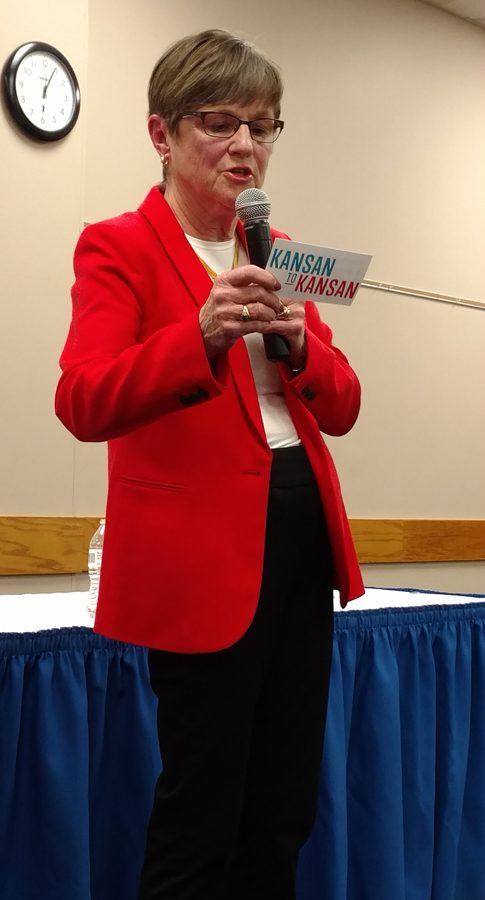
Kansas Gov. Laura Kelly spoke to a standing-room-only crowd during her stop in Salina Friday.
More than 130 people showed up to hear what Kelly had to say on a variety of topics prompted by questions from the audience during her town hall discussion in the Salina Chamber of Commerce’s Visit Salina Annex. And while more questions were turned in than were able to be answered, the audience was told that Kelly would answer the remainder of the questions on social media over the next few days.
Many of those in attendance stayed afterward to meet the governor or tell her what they thought about a particular subject.
Earlier in the day, Kelly met with local community leaders concerning workforce development issues.
School funding
Prior to the town hall discussion, Kelly told Salina Post that she was pleased with how the school funding measure turned out.
“It was just right. What the house and then the senate passed was exactly what we put into the budget, which we are very confident is what the court is asking us to do,” Kelly said. “We’re confident that it cannot only meet the court order but ensure that we’re adequately funding our schools.”
Moving to a more moderate state
Kelly said the passage of the school funding measure earlier this week was another sign that Kansas politics continues to become more moderate after moving far to the right under the Brownback administration. That moderate move, however, started in 2016, Kelly said.
“If you recall, in 2012, there was a concerted effort to remove moderate Republicans from the state legislature and it was very effective. So we no longer had what we always called the moderate majority for the first eight years I was in the senate. We didn’t have that after 2012,” Kelly told Salina Post. “But in 2016, I think the voters said ‘enough! We don’t want these extreme D.C. style politics here in the state of Kansas,’ and so they voted back in a number of moderates and a number of Democrats and because of that we were able to overturn the Brownback tax experiment in 2017. That sort of put us on the road to recovery that allowed us to do things like fund our schools.”
During the Salina Post interview, Kelly noted that just as the passage of the school finance legislation was a bipartisan effort, she has always worked in a bipartisan fashion and would continue to do so. She pointed out that even during her campaign, her endorsements were not limited to those from Democrats.
“I think that the very fact that I got elected suggests that we’re being successful in bringing Kansans together. During the campaign, we had some very prominent moderate Republicans, including former Governor Bill Graves, former Governor Hayden, U.S. Senators Kassebaum and Frahm who overtly endorsed my campaign, and actually Governor Graves campaign with me to make a statement that I was the one who could bring us together and keep us moving forward,” Kelly said.
“If you look at my cabinet appointments, it is clear that I am not running a partisan operation. It is an extraordinarily bipartisan group of folks who are coming in. We are gathering people around the table regardless of party to strategically plan to move Kansas ahead,” Kelly added.
Tax relief
Kelly told the Salina Post she has been consistent on the tax issue.
“We made radical tax changes in 2017 on a state level and in 2018 there were radical tax changes on the federal level. We really don’t know the full impact of those changes. We’ve got to wait and see when we have been through a full cycle what our bottom line looks like,” she said.
“So all I’ve asked legislators to do is just be patient. We will look at taxes. We just won’t do that right now because we don’t know,” Kelly said. “When they voted to slash taxes so much in 2012, it was blindly. They really had no idea and it was a lot worse than they expected because they weren’t dealing with good numbers.”
“I’m just asking them to be patient. I have every intention when the session is over of calling together people to look at our tax structure comprehensively. The worst thing we can do is this piecemeal kind of stuff because you make a change here, it makes a change there. We cut all those income taxes and people’s property taxes went up. The sales tax went up. So we need to take a comprehensive look and really crunch the numbers to know that whatever we’re proposing works in the long run,” she said.
Kelly told the Salina Post and then reiterated the idea during the town hall discussion, that what Kansas needs to do is move toward what Graves pushed for when he was governor: the three-legged-stool approach to taxes in which a third would be property taxes, a third would be income taxes, and a third would be sales taxes.
“So we will look at that, including the sales tax on food. I’m fully aware that when you combine state and local taxes, I think Kansas has the highest sales tax in the country and that’s not okay. So we will address that when resources allow and time allows us to do it properly,” Kelly said.
State brain drain
When asked what her administration would do to help keep the state’s brightest young people in Kansas, Kelly noted that one of the first things she did as governor was to sign an executive order that reinstated protections for LGBTQ state employees.
“Governor Sebelius issued that order. Sam Brownback rescinded it. I put it back in place. And the point of that was to send a very loud message, particularly to young people, that we are an open, accepting, welcoming state, because that millennial generation has no time for this kind of discrimination, and so I think we just had to let them know that ‘you can stay here and you can be proud to be a Kansan.’ That was an important step,” she said.
Additionally, Kelly said other initiatives to help keep young people from leaving the state include properly funding the education system and workforce development.
“We just met with some folks looking at job creation here in Salina. It’s important that we do that. It’s important that we have the technical school able to train the kinds of employees that those businesses will need so we will be working,” Kelly said. “My secretary of commerce was here with us today and that’s really his charge, to not only attract business but to help build the workforce, and that, I think, will help bring millennials back or keep them here.”
Rural Kansas
In a collaboration between the lieutenant governor’s office and the department of commerce, the Kelly administration has created the Office of Rural Prosperity.
“We’ve developed a very comprehensive, and I think doable, plan to work with our rural communities and help them determine their assets and what they can build upon to grow and to thrive or make some very tough decisions. I think by working with the communities, that’s going to help those farmers. If they’re living in an area that’s growing, they won’t be as ripe for picking off (by corporate farming),” Kelly said. “We’ve got to keep their schools open. We’ve got to keep their hospitals open. We have to make it possible to make a living and live for a farmer.”
Kelly added, “If you look at the rural prosperity plan, you’ll see that we deal with a lot of the issues: housing, roads, broadband, and the whole food desert thing we’ve got going on. It is absolutely imperative.”
Undoing the Brownback experiment
Kelly told the Salina Post that moving Kansas away from what it became during the Brownback years is going to be a lengthy process.
“It’s going to take a long time. The damage that was done is very broad and very deep and what we’re doing is taking sort of a triage approach and going after the most critical areas immediately so obviously our schools,” Kelly said.
She noted that some money was put “back in transportation because that is incredibly important to our communities.” Kelly also said that economic development and Medicaid expansion also were important.
Another area of importance to Kelly is the state’s foster care system.
“That really is a life or death situation so we have put lots of resources in there and inserted probably a national expert on child welfare who happens to have been a Kansan and who happens to have worked for the state in the social service agency before and was willing to come back and try to put that back together so we’re taking care of those kids and those families,” she said.
“I think the other thing that we’ve done immediately that will help is that we have really chosen a cabinet of experts and good managers who can go into these broken agencies and even within the limited resources, just their being there will make a huge difference,” Kelly said. “You can see it in our Department of Commerce with the leadership of David Toland and what he has been able to do because really, there are a lot of employees there who are gifted but who just haven’t had the leadership or the allowance to do what needs to be done. So, we can’t do everything right now, but there is a lot we can do just by inserting good leadership.”
Kelly said that after the triage efforts are complete, and time and resources allow, other issues will be addressed.
“Everything else is in the queue, there’s just a lot of things that need to be done,” she said.
Why be governor
Kelly said she thought it was her responsibility to run for governor. She readily acknowledged that she is not a native Kansan, but instead chose to make Kansas her home.
“I grew up in the military. My dad was career Army, and so we moved all over the place. My husband and I met and married in Denver, and after we had our first child, we chose to come to Kansas to make our home here,” she said. “We’ve been here now 33 years. I really love the state. It’s been very good to me and very good to my family.”
Kelly said her job with the Kansas Recreational Park Association “really allowed me to travel all over into every little town everywhere and I just came to love the people and love this state, love the culture”
She said it was painful to watch what was happening in the state during the Brownback years.
“I felt like I had the knowledge — I spent 14 years on the budget committee. I know state government probably as well as any legislator could. I have relationships in the legislature so it’s probably easier for me than for others to actually work with those folks. They know me and they trust me. So I really felt like I had the whole package that it would take to not only to become governor but to govern. I just thought it was my responsibility,” Kelly said.
The Kelly legacy
In taking on what she believes is her responsibility, what does Kelly want her legacy as governor to be?
“I want to fix the mess. That’s probably first and foremost, but when I look at a more positive approach to this, I would love to leave behind the most robust, sustainable early childhood system in the nation. I will do that working public-private with experts in that field in our local communities and try to put that in place so that it can live long past my time out of office,” she said.
Not just flyover country
Kelly told the Salina Post that she greatly enjoys Kansas’ culture of people helping people and people caring about one another, that sense of community.
“When we moved from Salina to Topeka — we did live here for a year and a half and then we moved over to Topeka — we lived in a neighborhood where my kids could go to school around the corner and there was the neighbor watching on her porch as they were walking,” she said. “Having been a military kid, I didn’t really have roots. My grandparents were all New Yorkers. My parents were both born and bred New Yorkers. I was born in New York but I didn’t have that sense of home, so coming here and running into fifth-, six-, seventh-generation Kansans, I just loved that. I like that sense of history.”
For those who give Kansas a bad rap, Kelly said she would want them to know great a state Kansas is.
“I’d want them to know what a wonderful place Kansas really is because it is. That’s why we stayed for so long. That’s why we raised our family here. It also is a place where my kids were able to do things that if we lived in a major urban area, in Chicago or New York or someplace else, they would not have been able to do because of the scope. The fact that it is smaller, more intimate — people know people — I think is important,” she said.
“I also think that if you’re trying to get people to move here, what they’re going to be looking at is your school system, so that’s why we need to put that all back together so we can use that we can use that as a selling point,” Kelly said. “Kansas, of course, given its geographic location, our transportation has to be second to none because that’s one of the reasons companies would move here, because they could move their goods. So we need to do that. And we need to take care of people. I see that happening through our Medicaid expansion and some of the other things we’re talking about.”
Video highlights
Below are some video clips from the governor’s town hall discussion. The first was in response to a question about how she could make headway with her administration’s agenda with determined Republicans in the legislature.
The second clip is Kelly’s response to a question about public employees.
The third clip is Kelly’s response to a question about school funding.